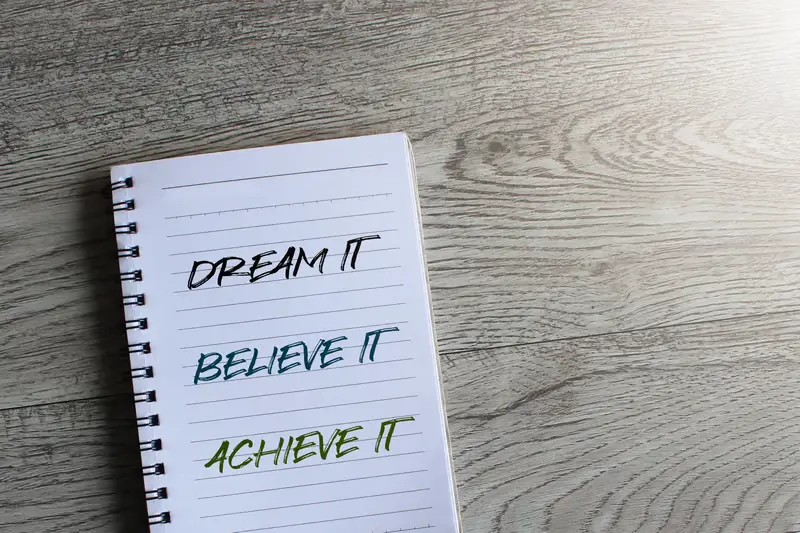
You know the routine. You scroll, find a line that hits you right in the chest, and save it. For about an hour, you feel ready to change your life. By the next morning, the feeling is gone, and so is any trace of what you planned to do. The quote was not bad. It just never told you what to do next.
That gap is the whole story. Generic motivation gives you a feeling. A quote built for actionable personal growth gives you a move, small enough to make today. This article shows how to tell the two apart, what research says about why one fades and the other sticks, and how to pick or write lines that can actually change your week.
Why Most Motivational Quotes Fade by Morning
Feeling Versus Doing
Most popular quotes are written to sound good, not to be used. They lean on big words like greatness, destiny, and limitless. They are easy to share, easy to agree with, and almost impossible to act on. Ask yourself what you would do differently after reading “Believe in yourself and anything is possible.” Nothing in that sentence tells you where to begin.
Actionable quotes work the other way around. They carry a verb, an object, and often a moment. They sound a little plain, and that is fine. The plainness is the point, because a line you can picture yourself doing is a line you can actually do. That is the difference between inspiration that passes and actionable personal growth that builds.
What Research Says About Positive Statements
Psychologists have tested what happens when people repeat upbeat lines to themselves. In a 2009 study in Psychological Science, Joanne Wood and colleagues asked students to repeat “I am a lovable person.” Those with high self esteem felt a little better. Those with low self esteem felt worse than people who repeated nothing at all.
The lesson is not that kind words are useless. It is that a statement clashing with how you really feel can backfire. Your mind argues back, and the argument wins. A quote works better when it points to a step you believe you can take, instead of a claim about who you are supposed to be. That shift is where actionable personal growth begins.
What Makes a Quote Actionable?
Five traits show up again and again in quotes that lead to action. None of them needs fancy language. Some of the best lines are blunt, and a few are centuries old. Once you know what to look for, you can sort any quote in a few seconds.
It Names a Specific Behavior
A good quote tells you what to do with your hands, your time, or your voice. In a common English translation of the Meditations, Marcus Aurelius writes, “Waste no more time arguing about what a good man should be. Be one.” The line has a clear instruction. Stop debating and start behaving that way.
Compare that with “Be the best version of yourself.” It sounds warm, but it never says what the best version does on a Tuesday afternoon. When you read a quote, look for the verb. If the verb is something you can film, such as write, call, walk, or ask, you have found something useful. If the verb is believe, become, or embrace, you have found a mood.
It Fits a Moment
Behavior changes more easily when it is tied to a cue. Psychologist Peter Gollwitzer calls these plans implementation intentions, and they follow a simple pattern: if this happens, then I will do that. A 2006 meta analysis by Gollwitzer and Paschal Sheeran pooled 94 tests and found a medium to large average effect of d = 0.65 on reaching goals.
Newer work is more modest. A 2024 meta analysis of 642 tests found a smaller average effect of 0.36, and 0.27 for behavior change specifically. So cues help, but they are not magic. Still, a quote like “Do the hard thing first” becomes stronger when you add a moment, such as “when I open my laptop, I start with the hardest task.” Good quotes often hint at that moment already.
It Is Small Enough for Today
Big promises scare people into doing nothing. A useful quote shrinks the task until starting feels easy. “Write one sentence” beats “Write a book.” “Put on your shoes” beats “Get fit.” Small steps are not a sign of low ambition. They are how habits form, because a step you finish today is worth more than a plan you admire tomorrow.
Research on habits backs this up, with a caveat. In a 2010 study by Phillippa Lally and colleagues, the 39 participants whose data fit the model took a median of 66 days to reach a plateau of automatic behavior, with individual estimates from 18 to 254 days. The study also found that missing a single day did not do much harm. So choose a quote that keeps the step tiny, and expect the habit to take longer than a month.
It Respects How You Feel
Strong quotes meet you where you are. “Do the next small thing” does that. It does not ask you to feel unstoppable, and it does not pretend the day is easy. It simply gives you a way to move while the doubt is still there. That honesty is why such lines survive a bad week.
Think back to the study on positive statements. People with low self esteem did better when they could weigh both sides of a claim than when they were told to focus only on the good. Quotes that admit difficulty feel more trustworthy for the same reason. They treat you as a capable adult having a hard day.
It Can Be Checked
At the end of the day, you should be able to answer yes or no. Did I write the sentence? Did I make the call? A quote like “Ask for the feedback you are avoiding” passes this test, because you either asked or you did not. A line like “Embrace your journey” never can, because nobody knows what counts as finished.
This trait is the most useful for sorting quotes quickly. If you cannot imagine a clear yes or no at the end of the day, the quote is probably generic. That does not make it worthless as poetry. It just means it will not carry you far as a tool for actionable personal growth.
Generic Versus Actionable, Side by Side
Three Quick Rewrites
Seeing the change helps. Take “Dream big.” It feels good and tells you nothing. A rewrite might be “Write down one thing you want and the first step you can take before lunch.” Now there is a task, a time limit, and a way to check it. The dream is still there, but it has handles.
Take “Never give up.” It is a fine slogan, but it gives no help at the exact moment you want to quit. Try “When you want to stop, do five more minutes, then decide.” That line meets you at the point of struggle. Next, take “Be the change.” A usable version is “Pick one habit you want to see in others and practice it today.” Each rewrite adds a verb, a moment, and a small size.
When a Famous Line Is Wrong
Sources matter too, and trust is part of why a quote works. Many people credit Aristotle with “We are what we repeatedly do. Excellence, then, is not an act, but a habit.” The line actually comes from Will Durant, who wrote it in The Story of Philosophy in 1926 while summarizing Aristotle’s ideas.
Does the mistake change the value of the line? Not much. Repetition is still the message, and it is a useful one. But checking the source builds good habits of its own. Before you print a quote on a poster or share it with a team, spend two minutes confirming who said it and in what context. A quote with a real source is easier to trust and easier to learn from.
How to Choose Quotes That Work for You
Match the Quote to Your Current Goal
A quote only helps when it fits what you are working on right now. If you are trying to finish a project, pick a line about starting or finishing. If you are building a fitness routine, pick one about showing up. Collecting fifty quotes does little. Choosing one that fits this month’s goal moves actionable personal growth forward.
Read the quote slowly and ask a plain question: what would I do in the next ten minutes if I took this seriously? If you can answer quickly, keep it. If your answer is vague, move on. A quote that makes you wince a little, in a good way, often points at the very thing you have been avoiding.
Write Your Own
The best quote for you may be one you write yourself. Use a simple formula with three parts: a time or place, a verb, and a small amount. For example, “After lunch, I send one email I have been dodging.” It is not poetic, and it does not need to be. It only needs to be true and doable.
Keep it short enough to remember without looking. Put it somewhere you will see at the right moment, such as on the lid of your laptop or on a sticky note by the kettle. Over time, a line like this becomes part of your day. That is a practical route to actionable personal growth, because the words carry you straight into the action.
Using Quotes in Daily Life
Pair Each Quote With One Cue
Choose one daily moment that already happens, such as pouring coffee, arriving at your desk, or closing the front door. Link the quote to that moment. When it happens, read the line and do the small step. Cues borrow strength from routines you already have, so you spend less energy remembering what to do.
Try this for one quote at a time, because steady actionable personal growth comes from focus. Rotating through ten at once splits your attention and weakens each cue. Give a single line two or three weeks, then decide whether to keep it. If the step has become automatic, you can raise the bar a little. If it still feels heavy, shrink it further and try again.
Where Quotes Fall Short
Quotes are helpers, not engines. A great line cannot fix a lack of sleep, an overloaded schedule, or a missing skill. Researchers who study planning also point out that cues do not replace motivation, ability, or resources. A plan can start a behavior, but it cannot do the work for you.
Conclusion
The difference between a quote that moves you and one that merely sounds nice comes down to a few traits. Actionable lines name a behavior, fit a moment, stay small, respect how you feel, and can be checked at the end of the day. Generic lines give a warm feeling and then fade by morning.
Start today. Pick one quote, or write one, and attach it to a single cue in your day. Make the step tiny and the check simple. That small, repeatable move is the heart of actionable personal growth, and it works far better than any collection of beautiful lines you never use.